Dictionary of Latin and Greek Theological Terms by Richard A. Muller
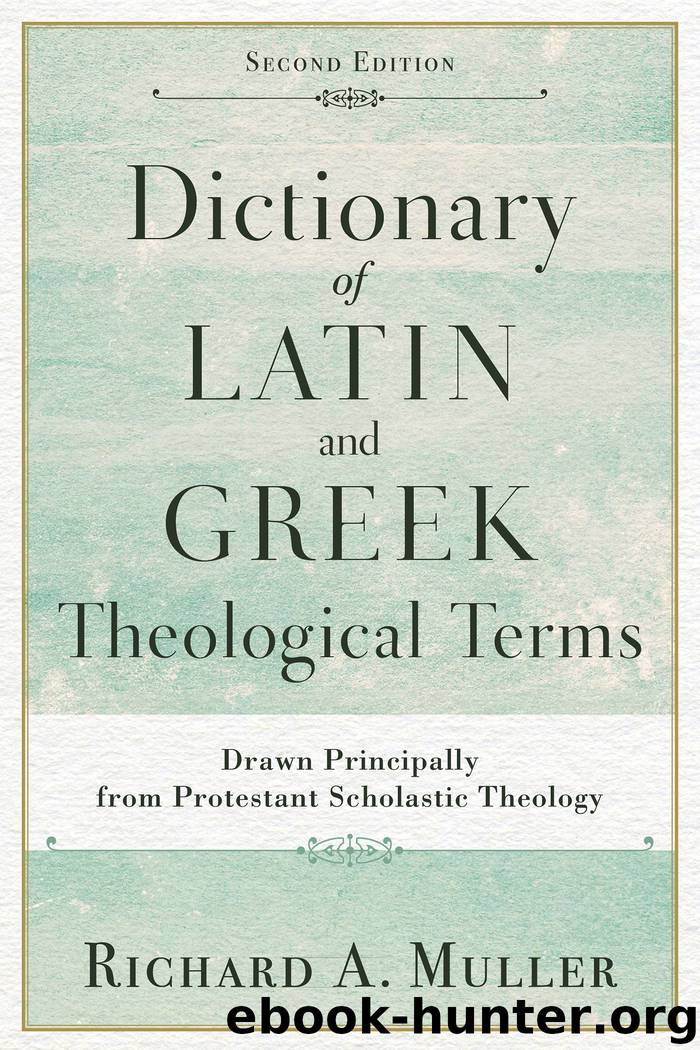
Author:Richard A. Muller
Language: eng
Format: epub
Tags: Theology—Dictionaries;Latin language—Dictionaries—English;Greek language—Dictionaries—English;Latin language—Terms and phrases;Greek language—Terms and phrases;REL067080;REL054000;REL093000
Publisher: Baker Publishing Group
Published: 2017-08-30T04:00:00+00:00
Mm
Back to Contents
macula: stain or blemish; specifically, spiritual pollution (pollutio spiritualis) and deformity of nature (deformitas naturae), i.e., the defilement of the soul that results from sin. See reatus.
Magis et minus non variant speciem: Greater and lesser do not vary according to species, or kind; an important philosophical axiom based on the fact that greater and lesser, albeit intrinsic, are quantitative and not essential or substantial characteristics. A tall tree is no more a tree than a shorter tree; their essence or substance is the same. See categoria.
magister: master; in the university, the title of one who has been awarded the first of the teaching degrees above the baccalaureus.
Magister dixit: The master said it; a reference to a saying by an authoritative teacher.
magisterium: teaching authority; i.e., the authority of the magister (q.v.); most frequently, the teaching authority of the church, the ecclesia docens (q.v.), according to Roman Catholic doctrine.
magnalia Dei: the mighty works of God. See opera Dei.
magnitudo: greatness, magnitude; as an attribute of God, the magnitudo Dei, the greatness of God in all his attributes, the greatness or magnitude of the divine essence itself. Specifically, magnitudo is used as a synonym for infinitude (infinitas, q.v.), both in terms of the divine immensity (immensitas, q.v.), or transcendence of space, and the divine eternity (aeternitas, q.v.), or transcendence of time. See attributa divina.
maiestas: majesty; i.e., the maiestas Dei, or majesty of God, the supreme eminence of the divine essence and attributes, usually paired with gloria (q.v.), the glory of God.
male velle: evil willing; the act of willing in an evil manner for the sake of doing evil. See velle malum.
malignitas: malignancy, maliciousness, spitefulness.
malitia: malice, wickedness, vice. See malum.
malum (n.) and malus, -a, -um (adj.): evil; the contrary or opposite of good; negation of the good. As defined by Augustine and argued by the scholastics, evil is not a thing or a substance. Since all things, as all the substances from which things are formed, are made by God, and since God created all things good, evil must be defined as having nonsubstantial existence, or as existing in the form of a defect (vitium, q.v.) or a privation (privatio, q.v.) in an otherwise good thing. Evil therefore cannot be an ultimate opposed eternally to the ultimate good; for its very existence evil depends on the existence of good. Nor can evil become absolute, since evil is a defect or a privation in and of the good; its increase toward the absolute results in the absolute privation of the good, i.e., in nonbeing or nothingness. Evil can also be defined, therefore, as the privation of being or as the result of a will moving away from being toward nonbeing.
Evil can be variously distinguished. Evil can be considered as either absolute (malum absolutum, malitia absoluta), as an imperfection or defect considered in itself; or relative (malum relativum), as the privation of a perfection in a thing. Note that, given the Augustinian understanding of evil, the malum absolutum cannot be a thing or a being in itself, which would imply a substantial or fundamental dualism, i.
Download
This site does not store any files on its server. We only index and link to content provided by other sites. Please contact the content providers to delete copyright contents if any and email us, we'll remove relevant links or contents immediately.
Periodization Training for Sports by Tudor Bompa(8332)
The Body: A Guide for Occupants by Bill Bryson(5180)
The MacArthur Bible Commentary by John MacArthur(4889)
The Sports Rules Book by Human Kinetics(4448)
What It Really Takes to Get Into Ivy League and Other Highly Selective Colleges by Hughes Chuck(3798)
Marijuana Grower's Handbook by Ed Rosenthal(3716)
The Sprouting Book by Ann Wigmore(3624)
The Martian by Andy Weir(3539)
Salt, Fat, Acid, Heat: Mastering the Elements of Good Cooking by Nosrat Samin(3176)
Harry Potter 4 - Harry Potter and The Goblet of Fire by J.K.Rowling(3132)
Sapiens and Homo Deus by Yuval Noah Harari(3111)
The Marketing Plan Handbook: Develop Big-Picture Marketing Plans for Pennies on the Dollar by Robert W. Bly(3105)
The Bread Bible by Rose Levy Beranbaum(3104)
Classic by Mary Berry(3053)
Martha Stewart's Baking Handbook by Martha Stewart(2887)
Screenplay: The Foundations of Screenwriting by Syd Field(2679)
The Plant Paradox by Dr. Steven R. Gundry M.D(2674)
50 Economics Classics by Tom Butler-Bowdon(2600)
The Cambridge Grammar Of The English Language by Rodney Huddleston Geoffrey K. Pullum(2451)
